Often we think about a topic in one or two ways alone, preventing us from fully understanding its complexity. Sometimes our solutions or strategies require more work. When you need a flurry of new thinking, conscious brainstorming is effective to develop your ideas. Conscious brainstorming is a do-it-yourself approach to decision-making and problem solving? It is designed to bring subconscious ideas into consciousness. It is like mining for gold, finding your spark of genius.
In some way, each of us has used individual or conscious brainstorming – had a great idea while in the shower or walking in the park. We often hear that inspiration can strike when you least expect it, but that is rather an inefficient way to drive innovation and creativity. If you havedeadlines and problems to solve, brainstorming by yourself may be critical to your success.
Some people brainstorm better alone. In fact, writers and problem solvers find it very useful. Often individual brainstorming can be more effective than group brainstorming, because on your own you are less constrained or more creative since you do not have to be concerned for another person’s opinion, personality, or ego. When you explore a challenge on your own, you might develop an idea that you would not bring up in a group setting. There is one drawback. When you work alone, you do run the risk of not developing ideas as fully, because you do not have immediate access to the wide experience or diverse perceptions that a larger group draws upon. Insightful individuals find ways to do both.
Some people struggle with getting their creative juices flowing. If this is new territory for you, there are ways to make the best of a situation that may be initially frustrating. Everyone needs a starting point. Here are some tips to make it easier to find your spark of genius.
When you find a way that works best for you, schedule weekly brainstorming into your calendar. You will be surprised what you can accomplish in just ten minutes.
To expand your average ideas into excellent ones you have to make a concerted effort to eliminate the self-destructive self talk such as:
- Yeah, but.
- This will never work.
- I can’t afford this.
- I don’t have the expertise or manpower.
- This is too complex.
Those kinds of thoughts will ruin your brainstorming session, for sure. Reverse or challenge your thinking. The key is to think through the problem in more than one way. Ask yourself the following questions and make sure you brainstorm several answers:
Ready to try conscious brainstorming to develop your ideas? There are a variety of brainstorming techniques that we will outline for you. No matter which you choose, be prepared for the ideas to flow. One idea will precipitate another so you will want to record your thoughts by writing them down.
Which brings us to the one simple rule for individual brainstorming: Write first, analyze later. Write everything down, including the unconventional, wacky or unusual. Later, you can focus on quality and cull for the best.
Here are some other tips:
There are several techniques that are ideal for conscious brainstorming. Depending on your project, challenge, or idea, one method may work better than others. For example, developing an idea for writing a term paper is different than brainstorming new product development.
We narrowed the list of individual methods down to the seven most popular and effective approaches that have proven to be reliable for individuals:
The first two on this list are more spontaneous less restrictive techniques. Approaches 3 to 7 are structured methods which you will use more systematically. These approaches utilize specialized questions that will help you to delve into related factors and explore new avenues of thought and gain an entirely new perspective to understand and evaluate an idea, challenge or product.
Rather than brainstorm by thinking a problem through you can freewheel by writing down everything and anything that comes to mind. You might start with a word or two based on your project or challenge, and begin writing down any word or thought that comes to mind. Be spontaneous. Write first. As you write down one idea another will present itself. Remember the goal is to analyze and strategize later.
Word association is slightly different to freewheeling. At the top of your page, write down the goal or question. Below that, write down the first four or five words that come to mind when you think of that solution. From there, focus on the first word on the list before you move to the next. Jot down the first words you think of when you hear each of those first words. Don’t over-think it. Your list can never be long enough. You should be surprised at the words that pop into your head.
The goal of Freewheeling and Word Association is to find those “hidden” gems, the ideas that you would not normally or immediately think pertinent to your question. When you have listed all your ideas, build on each idea and connect them in a diagram. Visualize each of them. You can hone in on what is sensible, what you like, what is right, what is practical, easy, cost effective, etc. You may find that reorganize the ideas is helpful.
 Starbursting explores solutions by asking questions related to the issue, challenge, or idea. In this technique, you create a six-cornered star. Spotlighted at the centre in writing is the issue or challenge. Each point of the star contains one of the following words: who, what, where, when, why, and how. With attention on each point, you generate all the possible questions starting with each of these words. Focus on thinking up as many questions as you can. Make sure the questions are relevant to the central topic or idea. Do not answer the questions. Afterwards, you can focus on each question to converge on the solution.
The goal is to explore how an idea will work. Say you are designing and building a new gadget, here are some questions you might ask.
Who:
Who will use this gadget?
Who will work on the project with me?
Who are my competitors?
Who can finesse the design?
Who will fix it if it breaks?
What:
What should I call it?
What does it cost to make?
What are the gadget’s weaknesses?
What can I do to ensure patent rights?
What colors will be most appealing?
What kind of free publicity can I get?
When:
When will I feasible get the product to market?
When will I start the advertising campaign?
When should I buy the equipment?
When can I realistically assemble a team?
Where:
Where will I get the funding for the project?
Where can I get it manufactured?
Where will I sell the gadget?
Where will I place the advertisement?
Why
Why had the competition not tried this already?
Why will people buy this gadget?
Why am I keen to launch this particular project?
Why will people want to buy this gadget?
What is it competitive better than other gadgets?
How:
How will this gadget help people?
How will this gadget fit into my businesses plan?
How will I get it made?
How can I build it stronger?
How many people do I need for this to work?
How will I promote it?
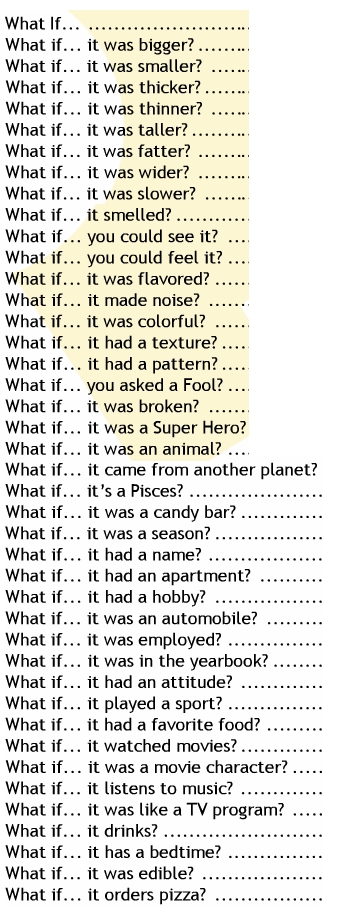
Want to think outside the box? To gain new perspective or reverse your thinking utilize the “What if” approach.
By asking “what if” you enter the world of pretend which can spur radical, creative thinking?
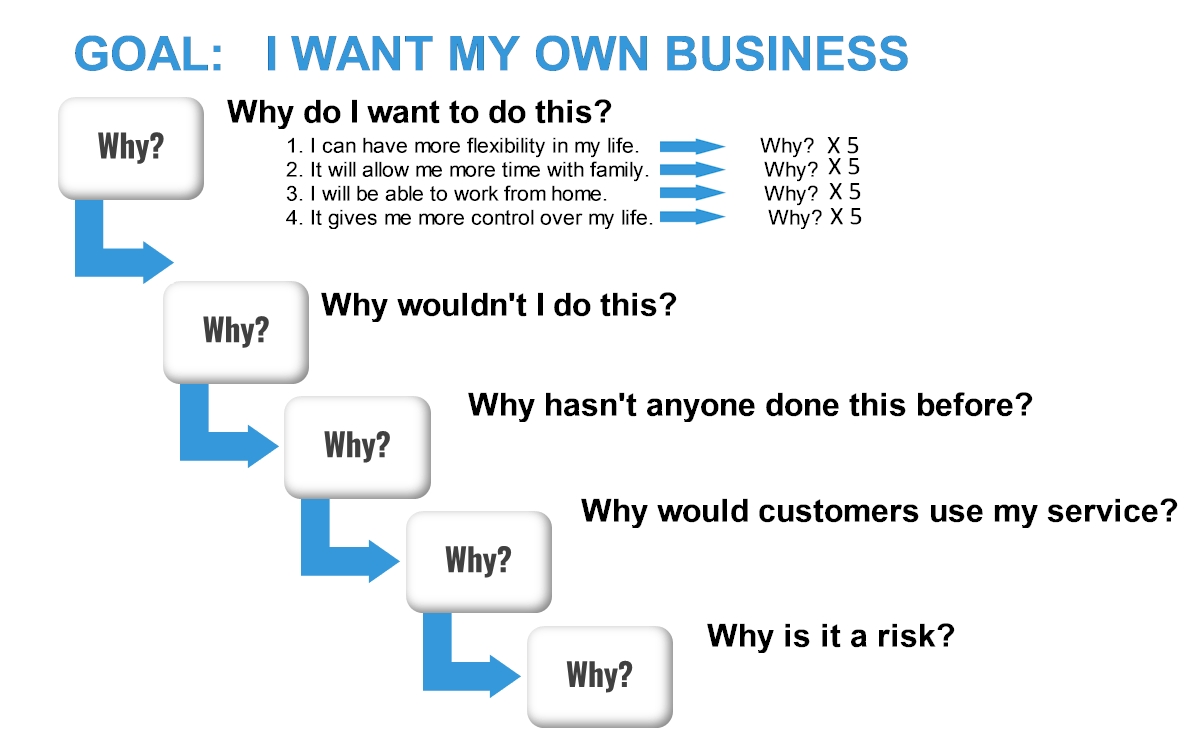
This technique addresses the challenge by asking the five why’s: Of course, the “five why’s” should be connected to their initial question and you should be smart about determine the five why questions. Or ask someone you trust to ask the initial questions. Answer the questions and then ask “five why’s” of each answer. Be spontaneous. Do this process at least five times. You end up with a long collection of answers that you can scrutinize.
No matter which method you choose, do not rush the analysis. This is where you will find quality gold and hidden gems, congruent patterns, or the innovative ideas that tell you something important
This technique addresses the challenge by asking the five why’s: Of course, the “five why’s” should be connected to their initial question and you should be smart about determine the five why questions. Or ask someone you trust to ask the initial questions. Answer the questions and then ask “five why’s” of each answer. Be spontaneous. Do this process at least five times. You end up with a long collection of answers that you can scrutinize.
Cubing is a popular writing technique. It is also an effective brainstorming strategy that involves focusing a little longer on an issue, challenge, or an idea to understand its complexity. By looking at a topic from six different angles you form new connections. Cubing is an excellent tool for generating new ideas and encouraging trains of thoughts to follow when writing on a specific topic.
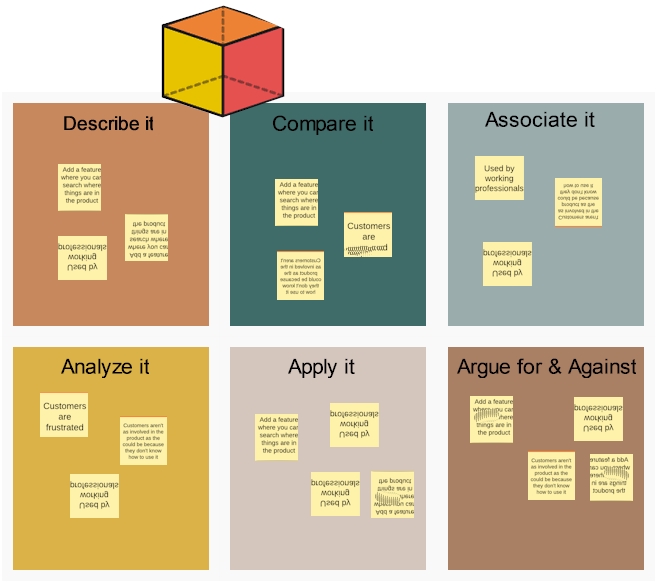
A cube has six sides. Basically with this method you arrive at a variety of answers to six specific questions. You could use six pieces of paper or divide a page into six sections.
Write down the question or desired solution at the top of the page. Then write down the answers to the following six questions:
Once you’ve completed each side of the cube, look at your responses to see if there are any emerging patterns. If this method works for you keep a cube on your desk for an inspirational reminder.
This Spider-Web technique is one method is a favourite among individuals and easy to employ.
This is a visual note-taking technique that diagrams your thought-processes. One idea will stimulate many other related ideas.
Write the topic or the problem in a circle in the middle of a page.
Draw lines out from the circle for subject headings. You could number each line. These subject headings become just possible ideas for solutions to the problem.
Here is an example. Say you have a transportation problem, and your main priority is going back and forth to work. Your subject headings might be:
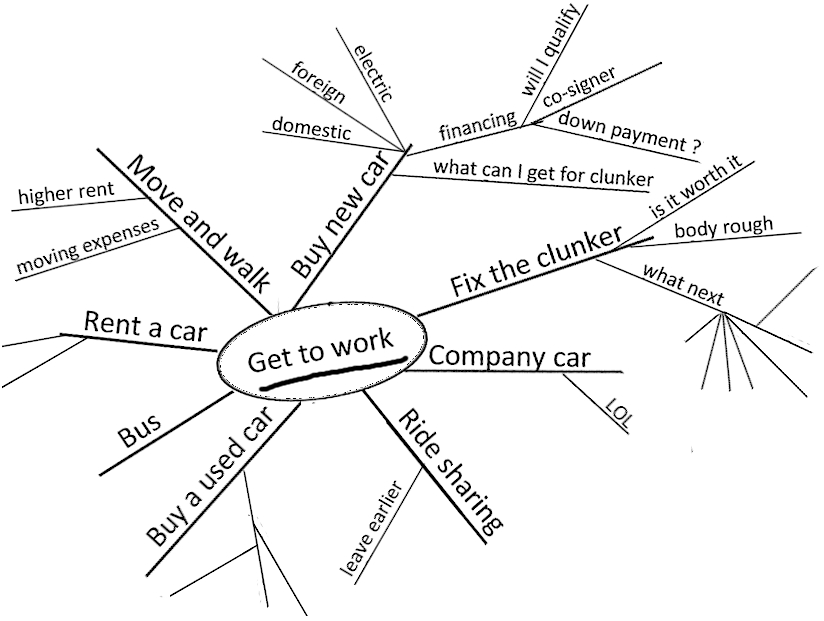
Next draw new lines out from the subject headings and write an idea — any idea — related to these subject headings.
Continue to create more layers as needed. Write freely to follow any train of thought without criticism. The idea does not have to make sense. Do not even think about whether your spider web is lopsided rather than symmetrical.
As a small business owner
you should assess whether you are sourcing enough good ideas from outside your
immediate think group. The more ideas generated, the greater the chance of
finding innovative ways to combine them into something new.
When you are active on social media you leave footprints that create a blurry line between your professional and personal life. All of it leaves a trail. When you compete for a job, a contract, or college admission, what is your digital imprint telling others?
Professionalism is what you do visibly that impresses and inspires others and what you do behind the scenes – integrity, self-regulation, conscientiousness – that allows you to fulfill your role to the best of your ability and gives you a sense of satisfaction and self-worth.
When you are overworked and under pressure, try these two super easy-to-implement strategies to fend off procrastination. They can be completed quickly and more importantly they work best to set the tone for an excellent day.
Kindness should extend to our colleagues and work family. In the workplace, kindness is a catalyst that helps to build trust, drives morale, improves well-being, engagement, and productivity. Kindness makes you feel good and that is a good way to spend your day.
As a professional, you want to get the job done – and done well. You do what is necessary to produce results that exceed expectations. You recognize whatever you do to keep advancing personally and professionally also helps you to thrive.