SWOT s an acronym for Strengths, Weaknesses, Opportunities, and Threats.
The SWOT Analysis strategy was devised as a planning tool for analyzing a professional project or business venture. It has since evolved into more than a business tool; it is a useful exercise for identifying and evaluating analyzing the various factors that can affect the attainment of your personal and professional goals and determine what abilities you need to acquire or fine-tune on your path forward as an entrepreneur. A SWOT analysis is a great way to organize, prioritize, and determine a workable strategy for your professional development as it pertains to your business as well as to create balance in your personal life.
A personal SWOT Analysis has a simplistic format which means it’s easy and quick to use. Basically four squares/four lists. No training required or special technology required. Paper and pen will work. To make it even easier we provide key prompting questions that will help stimulate your thoughts and keep you on track.
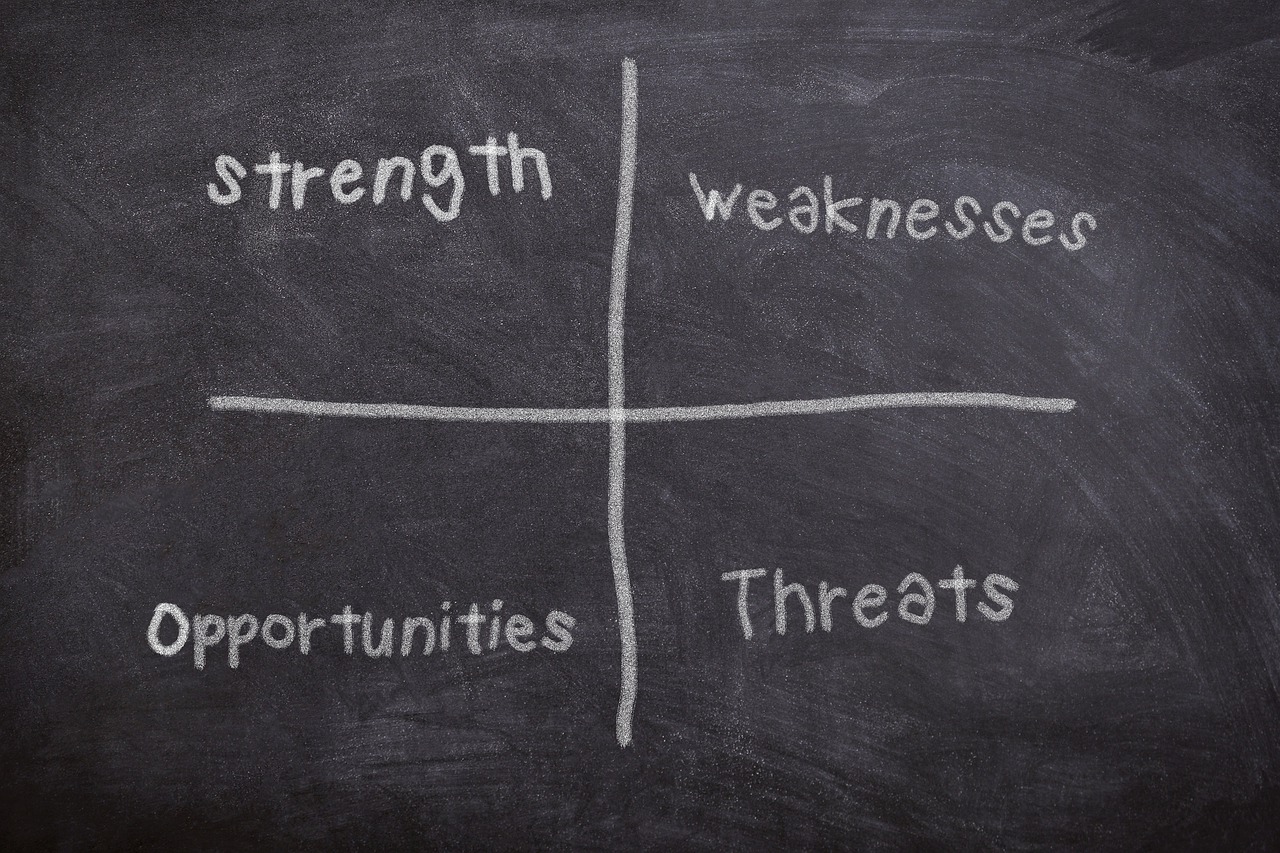
Listing everything down in a SWOT diagram will clarify your thoughts. It will help you identify the unique personal strengths that distinguish you. It’s a great confidence builder and way to affirm that you are on the right path or be reminded of your accomplishments. The SWOT process is also useful as way to handle a problem that you face because it enables you to identify which areas are of greater concern and where you need to focus your attention.
Of course, depending on your purpose, like any self-analysis tool, further in-depth study may be required. The main thing is that it is extremely helpful and definitely worth your time.
It is important to be as specific as possible. Be clear about timing. That is, when you want to achieve your goal. Also, determine what criteria you will use so that you will know that you have achieved it. As you go through the questions analyzing your strengths and weaknesses, it is helpful for you to consider your overall knowledge, skills, experience, resources as well as the support that you have available. These areas relate to you personally, and the resources and skills that are available to you. They are, therefore, things that are generally under your control.
Strengths refer to whatever you are good at, whatever motivates you, whatever you love to do – character traits, proficiencies, resources, or benefits that come from you or which you perform. Your strength help you to accomplish a task, sustain your passion, solve problems, make your work easier or achieve consistent results. Strengths can be intangible strengths including aptitudes, skills, positive behaviours, relationships, intelligences, and education. Don’t ignore your tangible strengths such as money, educational materials, specialized equipment, and amenities.
In advancing your career you would consider where you have an advantage over competitors/peers or where you have unique resources to exploit. Knowing your strengths will help you position yourself in whatever goal you want to achieve.
List your weaknesses or circumstances that make it more difficult for you or can prevent you from reaching a goal. Think about whatever is holding you back, whatever are your fears, whatever it is you dread. Think about behaviours that have affected your life personally, socially or professionally.
Ask these questions as a guideline to zero in on what might be holding you back.

Sometimes it is difficult to identify a personal weakness.
It may be difficult to admit your flaws or fears, but once you recognize what they are you can develop a plan to bridge those gaps or overcome those things that cause you to be anxious.
Identify any personal opportunities that could enable you to achieve the goal, and also that you will be able to take advantage of when you have achieved it.
Opportunities are generally external, relating to the environment and those around you, rather than you yourself. Usually, you can leverage these opportunities to help you achieve your goals faster or more effectively. They include things like industry financial incentives, government programs, a new lecture in your field of interest, events that are likely to happen at work or in your community. Consider the new opportunities that will open up as a result of achieving your goal. Consider the pros and cons as well as short-term and long-term benefits before disregarding an opportunity.
What choices can you make to take advantage of an opportunity that will guide you toward your personally and professionally? Once you know your choices you can check availability, schedule, and formulate a plan for self-improvement, education, professional growth and anything else that not only helps you personally, but advances you on your entrepreneurial path.
Think about all the external obstacles that may stand in your path or prevent you from following your personal or professional path. Anything that slows down or interrupts your progress can qualify as a threat. Examples of threats include a hostile employee, new competitors, disruptive technologies, distractive friends, and economic crises. What can you do when these things stand in your way?
Be aware that when creating a SWOT diagram, personal biases will shape your answers. The first step is being honest to yourself. This analysis is for you and not intended to impress anyone else. Although this is a self-assessment, asking others how they perceive you can lead to a deeper issue that you may not have noticed. Ask someone you trust for their opinions and be open-minded. Be aware, however, that when you ask another person about your strengths and weaknesses, he or she may have their own biases both for and against you.
Finally, as always with any development strategy you will have greater success if you review your analysis before you formulate any plan. Ask yourself:
You may want to leave your SWOT analysis for a day or two to let all the information sink in. Discussing elements of your analysis with people you trust will help you get more objective opinions and insight. Basically, SWOT analysis provides a better picture of all pros and cons you have professionally as well as personally. After you examine these details you can specify which are most important in each of the four categories. Then you can decide what types of enhancements, changes or strategies will lead to positive results and new opportunities.

In the final stage of your analysis you prioritize the actions or steps you intend to take:
You may have to view your priorities as phases of improvement. Figure out which short term steps or measures you have to take to get from where you are now to where you want to be. For example, deficiency in a basic skill can hinder learning the tougher stuff that requires higher skill levels. You cannot become a champion ice skater unless you know how to skate. You cannot be a journalist without having basic investigative, communication, and writing skills. What prerequisite skills do you need to enhance first? Allow time for developing both knowledge, experience, and proficiencies. Which ability will give you the experience you need to get to the next level? Don’t forget that behavioral changes also require time to develop into solid habits that you can rely on long term.
Develop a strategy and a realistic timeline for every priority on your SWOT analysis. To make your strategy more effective, specify on your timeline what you expect to be a quantifiable measure of performance or achievement for each objective.
The strategies you implement to reach your goals will require time and attention. Check your timeline to see that you are on track.
As a small business owner
you should assess whether you are sourcing enough good ideas from outside your
immediate think group. The more ideas generated, the greater the chance of
finding innovative ways to combine them into something new.
Inspiration can strike when you least expect it, but that is rather an inefficient way to drive innovation and creativity. Want a do-it-yourself approach to decision-making and problem solving? Try one of these brainstorming techniques to develop your ideas.
Professionalism is what you do visibly that impresses and inspires others and what you do behind the scenes – integrity, self-regulation, conscientiousness – that allows you to fulfill your role to the best of your ability and gives you a sense of satisfaction and self-worth.
When you are overworked and under pressure, try these two super easy-to-implement strategies to fend off procrastination. They can be completed quickly and more importantly they work best to set the tone for an excellent day.
Kindness should extend to our colleagues and work family. In the workplace, kindness is a catalyst that helps to build trust, drives morale, improves well-being, engagement, and productivity. Kindness makes you feel good and that is a good way to spend your day.
Are you familiar with the basics of copyright law in Canada? Do you know the finer points of protectecting your rights as the creator of intellectual property? Did you know that under Fair Dealing the users of copyright material also have rights under Canadian Copyright law?