Take heed! Remember – while you are
interpreting, either consciously or unconsciously, the body language of other
people, other people are constantly interpreting yours. Since words alone rarely reflect full or true
meaning and motive, what you communicate through your facial expressions, tone
of voice, where you stand, silence, the way you listen, react, move your
fingertips, breathe or twitch your lips has significantly more insightful
meaning.
People tend to pay more attention
to how you say something rather than what you actually say. They are more impressed by the information
they receive through your non-verbal communication you’re your words.
They pay attention to what you are
missing too. Your body stirs, moves and
sways in sync with your words; it continues to relay messages even when you
stay quiet.
Your reactions to another person’s
body language and their reactions to yours contribute greatly to mutual
assessment and understanding. Think
about your last experience where no words were exchanged, yet you understood
the feelings of another person in a single glance.
Typically, we are conscious of only a tiny fraction of the body language signals we are sending to others. Unfortunately, many people send confusing or negative non-verbal signals without even knowing it. When this happens, both connection and trust in a relationship can be damaged.
Consider what you may be conveying through your non-verbal cues. With every breath you take, your small or large non-verbal cues are busy telling the world something about you. Anyone listening or observing, who is adept at understanding the language of non-verbal communication, can determine the genuineness of your message. When your words, tone of voice, and body language tell the listener the same thing, chances are he or she is getting a genuine message of your emotions and intent. When you say one thing, but your body language shows a different pattern, the listeners are probably going to be on alert that you may be trying to deceive them in some way. Even when know what you are supposed to say or how you are supposed to react, when your non-verbal cues do not match your words, they can generate tension, mistrust, and confusion. Your non-verbal cues affect how others see you, how well they like and respect you, and whether or not they trust you. Never forget that others are diligent and attentive observers?
If you ever get lost in thought or forget this critical aspect of communication or if you are taking body language for granted, you may be sending the wrong signals. You might be saying very few words, but sending out thousands of nonverbal messages. Don’t forget that your body language is reflected in how you interpret or fail to interpret both the non-verbal and verbal communication sent by others? Other people can tell how engaged or distracted you are by how your body language responds to their verbal and non-verbal communication.
If you rely on words as the basis of your interpretation, while you are checking for messages on your phone, planning what you are going to say, or thinking about something else entirely, you are certain to miss the genuine subtleties of communication. You will end up not fully comprehending a great deal of what is being communicated and that will be reflected in your body language or what you do next. Think how easy it might be for someone to deceive you if you are not tuned in to recognize the non-verbal signals.
Through testing, the Princeton researchers learned that people in their study were accurate at perceiving others, but most were inaccurate about how others perceive them. Sadly, this lack of awareness can hurt a person. Even on the phone, people may not see your smile, but it definitely comes through in your tone. Unhappy or annoyed feelings do as well. If you have not given that much thought, it could be that your non-verbal messages are sabotaging your relationships or career. After all, like most of us, you are frequently blind to the effect you have on others because you simply do not see your own facial expressions, gestures and body language.
Ask trusted friends and family members to share which positive and negative displays of body language you use most often.
You can improve your outgoing non-verbal communication by learning to developing emotional awareness. When you can quickly identify your emotions and how they influence others, it helps you to display appropriate non-verbal cues to show others you understand or care. This also helps you to recognize the emotions of others and the true feelings behind the non-verbal cues they are sending.
Learning the language of non-verbal communications includes studying your non-verbal language cues. By being a conscious observer of other people, you become more adept at spotting and interpreting contradictions or miscues in others. At the same time, you will increase your self-awareness and self- control of your own cues, so that you can minimize sending out confusing, contradicting, or negative non-verbal messages.
Are you involved in a business or community project that requires you to do a lot of speaking? Have you ever recorded a video of yourself to get a sense of how your non-verbal communication complements or detracts from your presentation? Do you have a good sense of how your audience responds to you? You could ask a coworker, trusted friend, or expert in non-verbal community to observe both you and your audience to learn more about how your body language affects your delivery of a message. They can note your gestures and how you emphasize certain points that enhance or detract from your presentation.
Body language is not always kind, to others or to you. It is an integral part of who you are.
In the last few decades researchers have been studying embodied cognition which is the idea that our bodies are not only expressing our minds, but that the body can directly influence the mind in its own way. They engage in feedback from each other. Studies in this field reveal some remarkable insights:

Much of your body language happens. You probably don’t give it much thought; you just go along with it. However, looking at what the studies reveal, there are parts of your body that have the power to engage and alter your thoughts and these thoughts then feed your emotions in a kind of feedback loop that influences your mind and moods and how you subsequently act. Your emotions are reinforced—perhaps even driven—by corresponding facial expressions or body positioning.
Can you recall moments when standing or sitting up straight helped you breathe and project a stronger voice? Maintaining a good posture might just make you feel more relaxed and confident.
People who are trying to protect their image – public figures, celebrities, politicians – are more aware of their body language. They try to avoid obvious gestures of discomfort, defensiveness or stress. But since, they cannot fully control body language and their emotions are revealed in more subtle cues they claim they use certain postures because they feel comfortable doing so. It is likely more possible that the reason they feel good or comfortable, is because that body language actually reflects their authentic inner mood, not because they choose to display it. So remember, body language might make you feel good, but it might keep others away.
Ask yourself the following questions regarding your own body language:
Many people do not realize that they send out negative overt cues. You see, we are creatures of habit. We get used to sitting the wrong way or making the wrong gestures. We are also prone to imitating the body language of others and may not realize that how some behaviours affect our coworkers or family.
We all know someone who imitates the body language of celebrities or facial expressions they see on internet images. As an example: Thanks to several popular sitcoms, several celebrities close their eyes to demonstrate their frustration, irritation, and impatience. Actors exaggerated this facial expression for the benefit of the camera. The exaggeration is also a way to distract the viewer from authentic cues. Due to its overuse in comedy, people began to copy-cat these kinds of facial expressions as a tool of communication. However, in real life, sometimes it can be difficult to tell when it used for comedic purposes or actual frustration.
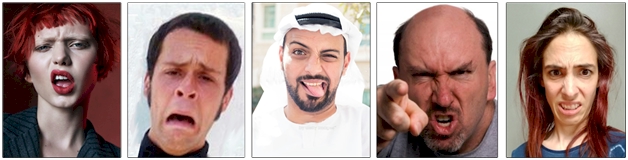
Images we see on the sitcoms and many we find on the internet are posed. The emotion we are copying is not real. Those adept at interpreting body language can detect when that emotion is faked in an image, and we can certainly comprehend fake in real life. These are just a couple reasons why it is so important to be conscious of your gestures because even if you are not, others will be.
Many people suggest that you can use body language to your advantage. To a limited extent, you can. You can establish good eye contact to convey conviction. When you meet someone for the first time, you can show respect with a firm confident handshake. You can make a conscious effort to control your body language to avoid sending negative signals that put others on the defensive. In difficult conversations, you can maintain a relaxed open posture and use receptive signals while you attempt to understand what others are saying and why.
To improving your nonverbal communication skills:
There is a lot less stress in being your authentic self and letting your body language flow naturally.
It is simply not possible for to control or suppress all your outgoing signals. When you put too much energy into body language or try to fake it, your calculated non-verbal pattern gets tangled up with your involuntary, genuine cues. The deliberate cues come across as insincere and phony; they overtly contradict the natural signals your body is conveying. At the very least, the mixed signals confuse others. Anyone listening or observing, who is adept at understanding the language of non-verbal communication, can determine the authenticity of your message. Even those not adept at interpreting non-verbal language can sense the disparity between the true and fake cues.
Designing how you will use body language can be a recipe for disaster if you are not being genuine. Social creatures that we are, we humans have a variety of emotions and attitudes. If you try too hard to apply the same gestures, such as looking joyful or friendly all the time you will appear fake or one-dimensional. When you try to impress people with overt repetitive gestures, they will often become suspicious, and it lowers trust between yourself and other people. Trying to force gestures in order to impress others or create some specific reaction in them, you inevitably sacrifice your own credibility. Remember it is what you do not say that counts.
Study “How to Become Skilled in Nonverbal Communication” by Toastmasters International