Listening means allowing someone else to be the focus of our attention. That requires patience and silence. Both can be a challenge for many of us because we are driven by our own needs and have an internal dialogue that is hard to subdue.
Negative listening behaviors can belittle the speaker or message. It takes skill to put our desires on the back burner and listen to the interests, concerns, or ideas of others.
Think of a time when you were too tired or
distracted to give your full attention to the ideas of a colleague or friend. What did you
do? What should you have done?
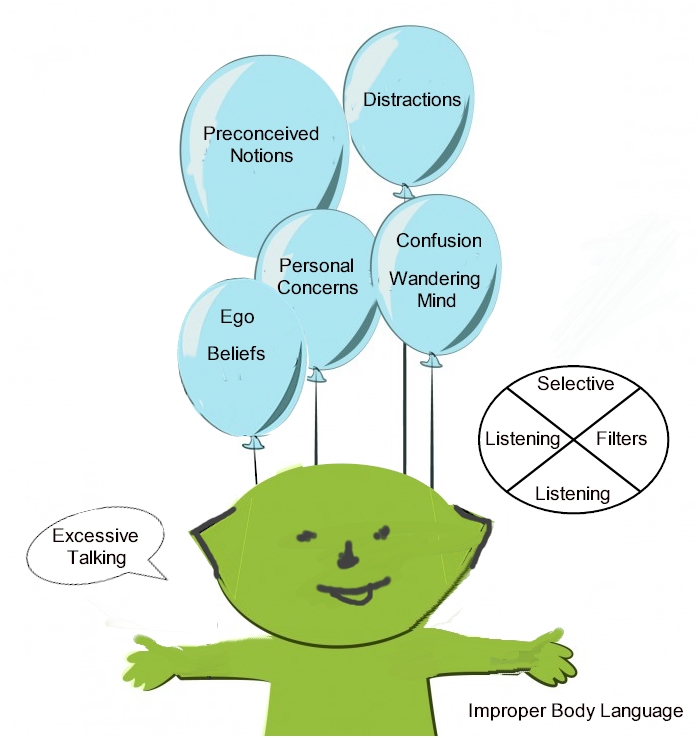
We have pinpointed fourteen different weaknesses or
underlying factors to effective listening.
If we truly want to get along with people we can improve our listening skills because all of these factors are within our control. Learn about these barriers. Recognize them as they happen. Then take steps toward improving your listening skills.
In our global economy or cultural rich society, language and cultural barriers can be seen in both social and business environments. In those situations you must focus attention to truly understand what is being said. Even then it could be challenging. Still give the person the courtesy to complete their thought before you seek clarification. It is a clear indication that you have been paying attention. It is also a sign of respect.
Often, we intuitively know when people are zoned out. Of course there are many physical signs that can be construed as rude and are clear signed that someone isn't paying attention: staring at a phone, fiddling with things or tapping fingers on the desk, fidgeting or looking around the room, slouching in chair, doing other tasks, or not facing the speaker.
Common courtesy dictates these four NO’s:
The bottom line is to avoid any behavior that belittles the speaker or message.
Now let's explore the weaknesses or underlying factors to effective listening and what you can do to overcome them.
Good conversational skills are an asset. However, when you talk more than is necessary, it is a barrier to effective listening and overall good communication. The truth is many people hesitate to interact with a person who talks excessively while failing to listen to others. Excessive talking can be perceived as aggression. You can overcome this obstacle by adopting the following habits:
You may not be able to escape the distractions of the various noises (physical noise, psychological noise, physiological noise, semantic noise, cultural), but you can manage them. The main types of distractions are physical, mental, auditory and visual. It may require advance planning to do whatever is necessary to minimize the physical, auditory and visual distractions. For example, it is difficult to concentrate when you are hungry or a jackhammer is pounding the pavement outside your office. It is equally difficult to pay attention to the speaker when you try to multi-task.
To minimize distractions:
Even when you eliminate the common distractions that break into your concentration, it can be difficult to stay focused for extended periods when you are tired, stressed, uncomfortable or perplexed. Do whatever you can so you are not running on auto-pilot and lack the energy to listen.
Listening filters prevent you from being fully present in communication. Specific listening filters are:
These filters may be triggered in situations where people hold authority over you, where you are concerned with obtaining approval, where you are only listening to solve a problem, when previous experiences have been unpleasant, or when what you hear arouses an emotion that diverts you from listening to the remainder of the message. Once you can pin-point the types of filters you use and under what circumstances you use them, you can employ strengths to remain focused.

With all you have to listen to, there are times when you experience information overload. You get tired or confused, forming coherent thoughts is difficult, and making a decision takes energy. That is when you are most likely to become overwhelmed and tune out at some point. When you do not have the luxury of going off the grid for a monastic retreat, you can moderate how you approach and manage the information that is coming at you. Studies show that you concentrate better and feel less stressed when you purposefully detach from work and enjoy real rest and relaxation breaks.
Before important meetings or lectures you can:
This can be a major obstacle to effective listening if you filter out or refuse to listen to what another person is saying simply because they hold different views. You should learn to appreciate that others do not share your opinions. In fact, their unique perspectives may shine light on problems and issues that you might not have identified or had to deal with before.
Everyone has biases, but good listeners have learned to hold them in check while listening. Good listening involves keeping an open mind, withholding your judgment, and treating the speaker with respect even when you disagree. When you listen you may have difficulty identifying your biases, especially when they seem to make sense. However, it is worth recognizing that our lives would be very difficult if no one ever considered new points of view or new information. We live in a world where everyone can benefit from clear thinking and open-minded listening.
Your inability to listen correctly can lead to misunderstanding what a speaker is trying to communicate. If you do not understand the message wait until the person has finished speaking and then ask questions for clarification. When that happens, you are not rude when you ask the speaker to clarify his or her words or intentions. Most people will appreciate the fact that you are making a focused effort to understand what they communicate.

You may not realize when you interrupt a conversation with improper body language or inappropriate words that have a negative impact on the other person. You can avoid this obstacle by:
Instead of listening to understand all that another person says, there may be times when you cannot wait to jump into the communication to tell your own story, offer judgment, advice, or make your sales pitch. The fact is you may have difficulty keeping your ego in check.
One of the most common ego-centric errors among average listeners is that they jump into too quickly to convey empathy or show they understand how the speaker is feeling. They may say things like, “I know what that is like,” and follow up the assertion with their own story of a similar situation.
It is challenging to understand another’s feelings if you only focus on your own feelings. You may need to remind yourself that other people have value, perspectives and experiences that are just as important as yours.
Selective listening is responding only to the parts of the speakers' remarks that interest you and rejecting everything else that was said. Selective listening occurs when you hear what you want to hear. You mentally filter out or tune out someone’s opinions or ideas when they do not line up with yours. You may think you may have heard the main points or have the gist of what the speaker wants to say and subsequently ignore or filter out the rest. When that happens, you may have a tendency to stop listening, allow yourself to become distracted, or change the subject thinking there is nothing more worth hearing. It is not a good way to build rapport. People tend to know if you are attentively listening to them. They tend to feel insulted if they catch you drifting off into your own little world when they are talking.
You may want to jump in early in a conversation and start to offer advice before you fully understand the problem or the concerns of the speaker. True people come to you with problems; they want to know they are not alone in their feelings; and they may want advice. However, you should make sure you have paid attention and understand the full message before relaying your thoughts.
You have a lot going on. It could be the everyday responsibilities of building a business, raising a family, studies, and working through personal issues. Sometimes when you are absorbed in your own concerns, you cannot focus on what others say. To eliminate psychological noise, you have to give yourself permission to park those worries in a safe place so you can focus on the speaker.
To eliminate psychological noise, you have to give yourself permission to park those worries in a safe place so you can focus on the speaker.
Emotional barriers are challenging because they are personally sensitive factors in communication. They make it challenging to focus on the speaker or to engage in conversation. It could be a positive emotion such as being excited about landing a new contract which draws your concentration away from what you should be hearing. A negative emotion – being angry or upset about something going on in your life – makes it less likely that you will be very receptive to what another person has to say.
When you recognize that your emotions will be a distraction and a hindrance, you should try to refrain from engaging until you have your personal feelings in check. Identify what you are feeling and give yourself some space. A few moments to breath or take a brief walk might be enough. If they are intense emotions you may more time. Find an outlet to express yourself privately or in a journal.
Time pressure can come from within oneself or from an external source. This barrier is solely in your control. When another person requests time to speak with you, you know what is pressing and what isn’t. You either decide to make time right away, or if you are under pressure and feel that you do not have enough time to listen be honest and tell the other person when you will be available. There is no sense in wasting anyone’s time if you are unable to focus on what they are saying, become impatient or start preparing to leave for another appointment.
 Most people speak at a rate of 125 words per minute. As a listener, we can filter 500-700 words a minute. If we can process so many more words than we actually hear, a mental lag can occur. Eventually, we stop listening or drifting in and out. To keep ourselves engaged, we should be able to detect the subtleties of speech and mannerisms, mentally recap the speaker’s ideas, and link those ideas together to make better sense of the message.
You may want to jump in early in a conversation and start to offer advice before you fully understand the problem or the concerns of the speaker. True people come to you with problems; they want to know they are not alone in their feelings; and they may want advice. However, you should make sure you have paid attention and understand the full message before relaying your thoughts.
Because listening requires conscious mental effort you want to eliminate as many cognitive barriers as you can beforehand. You can prime yourself to listen more effectively by determining your goals for listening to any message so you can choose the best approach to listening. You should determine: “Does this message relate to me or affect my life?” Then ask questions:
You have a purpose in any given listening situation, whether it be a discussion with fellow entrepreneurs, attending a lecture, or visiting with a friend. Actually, you might have more than one purpose. For example, in a classroom lecture, your primary purpose might be to learn and understand a new theory and your secondary purpose might be to glean clues as to what parts of the lecture will be included in the final exam. When you know your goal, you can choose how best to pay attention and determine how you will gather and understand all the information you need.